Walden Bello, senior analyst of Focus on the Global South and
professor of sociology at the University of the Philippines, is one of
the leading critics of the current model of economic globalisation,
combining the roles of intellectual and activist. As a human rights and
peace campaigner, academic, environmentalist and journalist, and
through a combination of courage as a dissident, with an extraordinary
breadth of published output and personal charisma, he has made a major
contribution to the international case against corporate-driven
globalisation.

Bello was born in Manila in
the Philippines in 1945. He was studying in Princeton for a sociology
Ph.D in 1972 when Ferdinand Marcos took power, and plunged into
political activism, collecting his Ph.D, but not returning to the
university for another 20 years. Over the next two decades, he became a
key figure in the international movement to restore democracy in the
Philippines, co-ordinating the Anti-Martial Law Coalition and
establishing the Philippines Human Rights Lobby in Washington.
He
was arrested repeatedly and finally jailed by the US authorities in
1978 for leading the non-violent takeover of the Philippine consulate
in San Francisco. He was released three weeks later after a hunger
strike to publicise human rights abuses in his home country.
While
campaigning on human rights he saw how the World Bank and IMF loans and
grants were supporting the Marcos regime in power. To expose their
role, he took the risk of breaking into the World Bank headquarters in
Washington, and brought out 3,000 pages of confidential documents.
These provided the material for his book Development Debacle: the World Bank in the Philippines (1982),
which became an underground bestseller in the Philippines and
contributed to expanding the citizen's movement that eventually deposed
Marcos in 1986.
After the fall of Marcos,
Bello joined the NGO Food First in the USA, and began to expand his
coverage of the Bretton Woods institutions, in particular studying the
'newly industrialised countries' of Asia. His critique of the Asian
economic 'miracle', Dragons in Distress, was written six years before the financial collapse that swept through the region.
His
recent work has been criticising the financial subjugation of
developing countries and promoting alternative models of development
that would make countries less dependent on foreign capital.
In
1995, he was co-founder of Focus on the Global South, of which he later became executive director. Focus seeks to build grassroots capacity to
tackle wider regional issues of development and capital flows. When the
Asian Financial Crisis struck two years later, Focus played a major
role advocating a different way forward.
Bello
argues that "what developing countries and international civil society
should aim at is not to reform the WTO but, through a combination of
passive and active measures, to radically reduce its power and make it
simply another international institution co-existing with and being
checked by other international organisations, agreements and regional
groupings. It is in such a more fluid, less structured, more
pluralistic world with multiple checks and balances that the nations
and communities of the South will be able to carve out the space to
develop based on their values, their rhythms, and the strategies of
their choice."
At the abortive WTO meeting in
Seattle in 1999, Bello played a leading role in the teach-ins around
the protest events and was later beaten up by the Seattle police. He
was detained again by the Italian police and nearly run over by a
police car at the 2001 G-8 summit in Genoa. He also played a key role
in civil society circles in elaborating the strategy to derail the WTO
Ministerials in Cancun in September 2003 and in Hong Kong in December
2005. In September 2006, he was banned by the Singapore government
from entering the island state to attend the World Bank-IMF annual
meeting, a repressive act that was criticized by World Bank President
Paul Wolfowitz himself.
He
has also played a leading role as an environmentalist, and is former
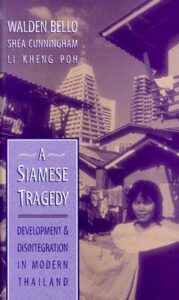
chairman of the board of Greenpeace Southeast Asia. His 1998 book A Siamese Tragedy,
documenting the environmental destruction of Thailand, became a
bestseller there and won praise from former Thai Prime Minister Anand
Oanyarachun. It received the Chancellor's Award for best book from the
University of the Philippines in 2000.
Bello
has campaigned for years for the withdrawal of US military bases in the
Philippines, Okinawa and Korea, and has helped set up several regional
coalitions dedicated to denuclearisation and demilitarisation, and a
new kind of security plan based on meeting people's needs.
After
September 11 2001, he was a leading voice from the South urging the USA
not to resort to military intervention - which he believed would
exacerbate the problem - but to tackle the root causes of terrorism in
poverty, inequality, injustice and oppression. In March 2002, he led
the peace mission to the southern Philippine island of Basilan, where
the US army recently sent their special forces. He was also one of the
leaders of a peace mission of Asian parliamentarians and civil society
activists that visited Baghdad in March 2003 in a last-ditch effort to
stop the US invasion of Iraq. He led another mission to Lebanon at the
height of the the Israeli bombing and invasion of that country in
August 2006.
Bello's current and immediate past roles include:
- President of Freedom from Debt Coalition.
- National
Chair Emeritus and National Chair of the party Akbayan, one of the
fastest growing parties in the Philippines, which has three members in
the Philippine Congress
- Professor of sociology and public administration at the University of the Philippines.
- Executive director of Focus on the Global South.
- Member and former Chair of the board of Greenpeace South East Asia.
- Board member of Food First, the International Forum on Globalisation, and the Transnational Institute.
Bello has won praise for his writing, as the author or co-author of 14 books on global, Asian, and Philippines issues, notably American
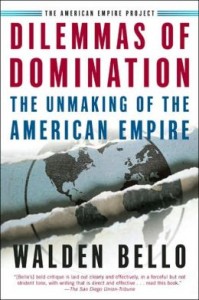
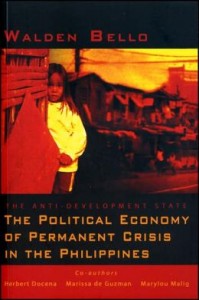
Lake: The Nuclear Peril in the Pacific (1984) (co-authored with Peter Hayes and Lyuba Zarsky), People and Power in the Pacific (1992), Dark Victory: The United States and Global Poverty (1999), Global Finance: Thinking on Regulating Speculative Capital Markets (2000) and The Future in the Balance: Essays on Globalisation and Resistance (2001); The Anti-Development State: the Political Econmy of Permanent Crisis in the Philippines (2004); and Dilemmas of Domination: the Unmaking of the American Empire (2005). His articles have appeared in numerous periodicals including Review
of International Political Economy, Third World Quarterly, Foreign
Policy, Race and Class, Le Monde Diplomatique, Le Monde, Guardian,
Boston Globe, Far Eastern Economic Review, and La Jornada. He is currently a columnist for the Philippine Daily Inquirer and Foreign Policy in Focus. He won the New
California Media Award for Best International Reporting in 1998.
Bello
was awarded South Korea's Suh Sang Don Prize in 2001. In 2003, he
was given the Right Livelihood Award, also known as the Alternative
Nobel Prize, for "... outstanding efforts in educating civil
society about the effects of corporate globalisation, and how
alternatives to it can be implemented." The Belgian newspaper Le Soir
called Bello "the most respected anti-globalisation thinker in Asia."
Canadian author Naomi Klein has called him the "world's leading
no-nonsense revolutionary." Chalmers Johnson has hailed him as the
"world's best guide to American exploitation of the globe's poor and
defenseless."
An
academic as well as an activist, Bello obtained his PhD in sociology
from Princeton University in the US in 1975 and has been a full
professor at the University of the Philippines at Diliman since 1997.
He has also served as visiting professor at the University of
California at Los Angeles (2002), UC Irvine (2006), and UC Santa
Barbara (2006). He also taught for four years, 1978-82, at UC
Berkeley. He was Chancellor's Fellow at UC Irvine in 2004 and was
awarded an honorary PhD by Panteion University in Athens, Greece, in
2005.
|